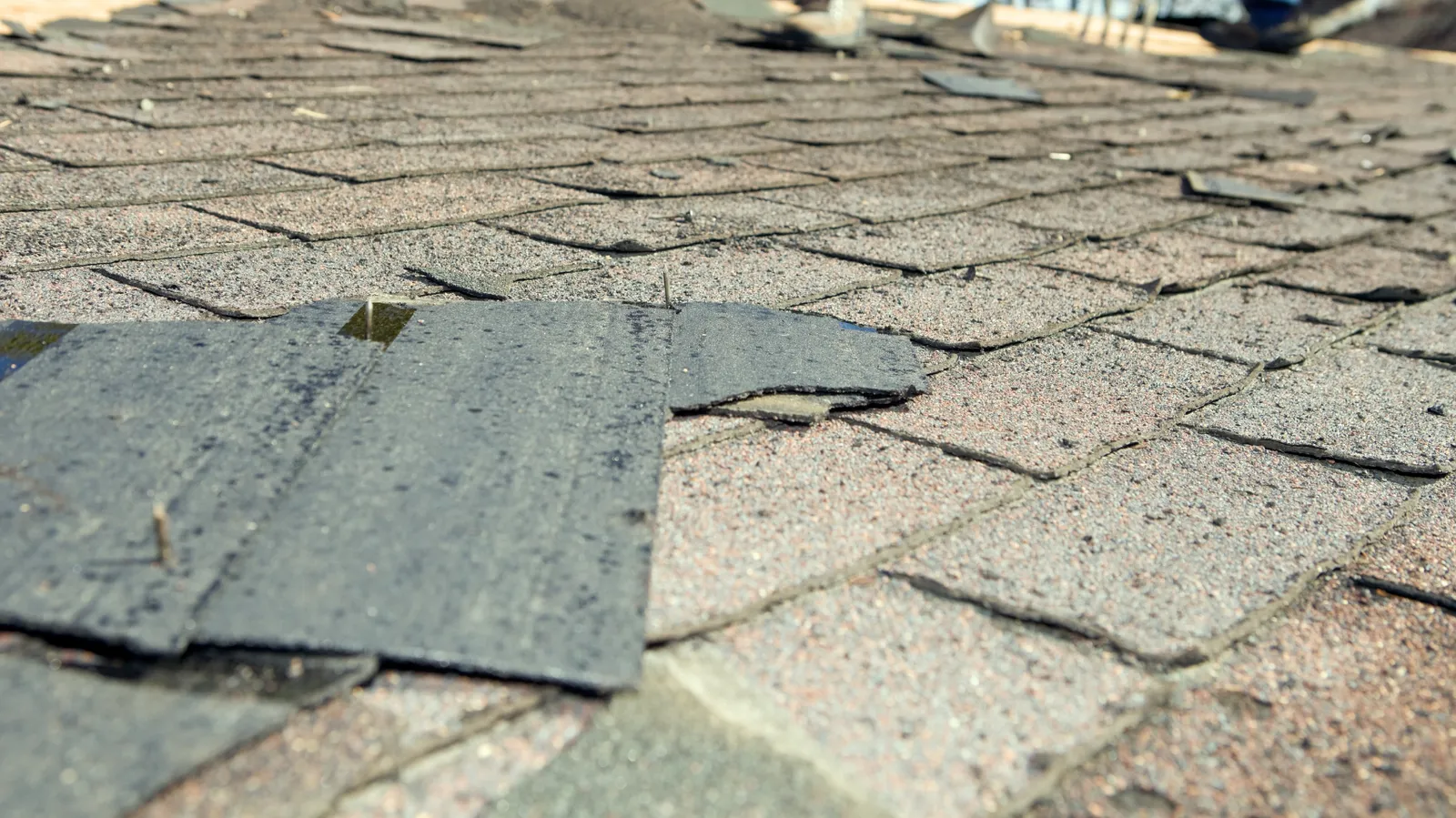
On June 15, 2023, hail measured at 5.90 inches, larger than a grapefruit, came down in Denton County near Sanger, part of a four-year stretch that logged 33 separate hail days over the area. A stone that size is not subtle when it lands. But most hail is smaller than that headline number, and the damage it leaves is easy to misread in both directions: homeowners panic over marks that mean nothing and shrug off bruises that will cost them a roof. The goal here is to read a roof honestly. Real hail damage has a specific look and, more importantly, a specific consequence, and a lot of what gets mistaken for it is just a roof aging in the sun. Here is how to tell the difference, why even a newer lakeside roof still gets hit, and when it is worth having a documented storm inspection rather than guessing from the driveway.
A bruise is not a scuff: what hail does to a shingle
Hail damage on an asphalt shingle is a bruise, and the word is literal. When a stone hits hard enough, it knocks the protective granules loose and dents the mat underneath, leaving a soft, often circular spot where the surface gives slightly under a thumb, the way a bruise does on fruit. The granules are not decoration; they are the shingle's sunscreen, and once they are gone the asphalt below is exposed to UV and begins to break down. That is why a bruise you can barely see today becomes a brittle, cracking spot a year or two from now.
The pattern matters as much as the mark. Real hail hits are random and scattered across a slope, heavier on the faces that took the storm's direction, and they show up on the soft metal too: dents in vents, gutters, and flashing that a stone leaves as a matching record. What a roofer looks for is that consistent, random bruising across a whole plane, not one odd blemish, because hail does not strike a single shingle and stop.
The marks that fool people
Plenty of roof marks look alarming and mean nothing about hail. Blistering, small raised bumps where gas escaped the asphalt during manufacture or later heat, can pop and shed granules in a way that mimics a hail bruise, but it is round, regular, and unrelated to any storm. Normal granule loss from age gathers in the gutters of every older roof. Dark streaks are usually algae, not damage. Scuffs and shiny spots often come from foot traffic or a dragged branch, and factory flaws sit in patterns hail never makes.
Telling these apart is exactly where an untrained eye and a storm-chaser's flashlight both go wrong, in opposite directions. Cosmetic marks get sold as a claim an adjuster will deny, and real bruises get dismissed as normal wear until they leak. The honest read is not a guess shouted from the driveway; it is a close, dated look that matches the roof to a real storm. If a hail damage inspection cannot tie the marks to an event on the record, it should say so.
Why a newer lakeside roof still gets hit
There is a comforting myth that a newer roof is a hail-proof roof, and The Colony's geography quietly disproves it. The Tribute and Stewart Peninsula sit on a peninsula reaching into Lewisville Lake, largely built out in the late 2000s and 2010s, so what's out there skews young. But age has little to do with whether hail bruises a roof; a 5.90 inch stone does not check the install date. Open water gives a storm an unobstructed run, so wind-driven hail on the peninsula often hits harder, and at a sharper angle, than it does a few miles inland.
That combination, newer roofs and heavy lakeside exposure, is why storm response, not age, drives most of the roofing work on that side of town. A three-year-old roof in The Tribute can take real damage in a single afternoon while its warranty is still current, and a manufacturer's warranty does not cover a storm. So the useful question after a hard hail day is not how old is the roof but did this storm reach it, and that is a question the roof answers only when someone looks closely at every slope.
The real tell is time, not just the surface
The trickiest thing about hail damage is that it rarely announces itself. A bruised shingle usually does not leak the week of the storm; it leaks a season or two later, once the exposed mat has weathered and cracked and the next hard rain finds the opening. That gap between the storm and the symptom is the whole problem, because by the time a ceiling stain appears, the storm date is old news and the cause is harder to prove.
This is why timing beats appearance. The most useful move after a known Denton County hail day is not to wait for a leak; it is to get the roof documented while the storm date is fresh, whether or not anything looks wrong from the ground. A dated set of photos taken close to the event is what ties a future leak back to a covered storm, instead of to years of unproven wear. The roof does not heal while you wait, and the evidence only gets weaker.
When a documented inspection is worth it
Not every roof needs a ladder after every storm, so it helps to know when a look is worth it. A documented inspection is worth booking after a genuinely hard hail day, when neighbors are filing or replacing, when the soft metal around the house shows fresh dents, when the roof is older or a warranty is nearing its end, or when a storm predates a sale or a claim you might file. If none of that applies and no clear signs are present, honest advice is to note the date and watch, not to chase a claim that is not there.
When a look is warranted, what you want is documentation, not a sales pitch: a local roofer who walks every plane, dates the photos, and tells you plainly whether the damage rises to a claim or does not. That last part is the mark of an honest inspection, the willingness to say a roof is fine and walk away. The roofer inspects and documents; the decision to file, and the claim itself, stay yours.
- 1. Note the date of any hard hail day, even if nothing looks wrong yet
- 2. Scan for the real tells: bruised, granule-bare shingles and dented soft metal, not just surface marks
- 3. Start with a documented inspection and let the roof, not a guess, decide whether it rises to a claim
Think a recent hailstorm may have found your roof? Tell The Colony Roofing Experts what you noticed, and a local roofer will take a documented look at every slope, then tell you straight whether it rises to a claim.
Contact us Call (469) 234-3704